
Appoggio for Every Voice: Why the Italian School Is the Best Foundation for All Singers
· @Irene
"But I don't want to sound like an opera singer". The actor/singer in front of me, certainly not a rookie in Dutch theatres, is looking at me in shock. I explain to him that appoggio is merely an Italian name for the classical breath support, but one that is actually anatomically correct, as the lung doctor I interviewed also confirmed. And as he has been singing too long with a low chest, something he learned from a not so complete vocal technique, and has very little control over his voice.
We work for a few weeks, he has several "aha-moments", and after that, he feels much better. He can sing long phrases and the higher register isn't giving him problems anymore. He feels more confident singing high notes on stage.
"Arrivederci" he shouts, as he leaves the studio.
Learning the classical Italian School of Singing does not mean you will end up sounding like an opera singer. It means you learn to use your voice the way it was built to be used: freely, healthily and for a lifetime.Whether you sing musical theatre, pop, jazz, soul or rock, the same instrument is at work. The same lungs, the same ribs, the same vocal folds. The Italian School, and above all its principle of appoggio, is simply the most thoroughly tested system ever developed for managing that instrument. Its teachers refined it over more than two centuries, long before microphones existed, because singers had nothing else to rely on.
What the Italian School and appoggio actually are
Appoggio comes from the Italian appoggiarsi, "to lean upon". It is the hallmark of the historic Italian School of Singing.
In 1890 Francesco Lamperti described it as the support the muscles of the chest, especially the diaphragm, give to the voice by acting on the air in the lungs. A century later the American pedagogue Richard Miller widened the definition. In The Structure of Singing he argues that appoggio cannot be reduced to "breath support", because it unites breath management and resonance. The old Italian masters never separated the two.
In practice, appoggio means a dynamic balance. The muscles of inhalation keep working gently while you sing, so the breath is released slowly and evenly instead of rushing out. Lamperti called this balance la lotta vocale, the vocal struggle. The result is steady pressure beneath the vocal folds, a freely vibrating larynx and a tone that carries without force.
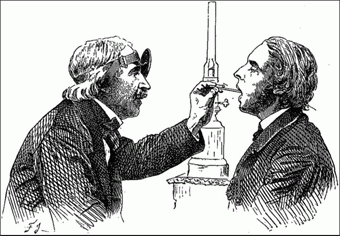
The Italian School was also the first to put science at the heart of singing. In 1854 the singing teacher Manuel García II became the first person to watch a living larynx in action, using two small mirrors and sunlight. He presented his findings to the Royal Society in London in 1855 as Observations on the Human Voice. His invention, the laryngoscope, is still the basis of every ENT examination today.
Why it works for every genre
Style lives on top of technique; it does not replace it. A belt, a jazz phrase and a pop riff all start in the same place: air meeting the vocal folds. Appoggio gives every style three things it needs.
- Breath support. Steady, balanced breath pressure lets you sustain long phrases, sing softly without losing the tone and build volume without pushing from the throat. That matters as much on a 300-seat Broadway stage as in an opera house.
- Expression. When the breath is under control, the voice is free to colour, bend and shade the music. Dynamics, rubato, a sudden whisper or a ringing climax all become choices rather than accidents.
- Tone production. Because appoggio links breath and resonance, the voice finds its natural ring and carrying power. You are heard clearly, with less effort and less strain on the vocal folds.
The Italian School does not dictate how you should sound. A pop singer keeps a pop sound, a jazz singer a jazz sound. What changes is the foundation underneath: a voice that is healthier, more flexible and more reliable night after night.
The stars who built on a classical foundation
Some of the most celebrated voices outside opera owe their stamina and freedom to classical training.
Audra McDonald, Broadway
With six Tony Awards, Audra McDonald holds the record for the most acting Tonys of any performer. She studied classical voice at the Juilliard School under Ellen Faull and graduated in 1993. She has said she wanted to be a belter, but Juilliard showed her she had a classical instrument, and that it became part of who she is. A year after graduating she won her first Tony for Carousel. To this day she keeps taking lessons: in her words, "You must always continue to study voice."
▶ Watch:Audra McDonald on YouTube
Kristin Chenoweth, Broadway
The original Glinda in Wicked earned a bachelor's degree in musical theatre and then a master's degree in opera performance at Oklahoma City University in 1992. That training is audible in her signature showpiece, "Glitter and Be Gay" from Bernstein's Candide, one of the most demanding coloratura arias in the repertoire, which she sings with comic timing and seemingly effortless high notes.
▶ Watch: Kristin Chenoweth, "Glitter and Be Gay", Candide in Concert (2005)
Cécile McLorin Salvant, jazz
One of the most acclaimed jazz singers of her generation began classical voice lessons as a teenager and studied classical and baroque voice at the Darius Milhaud Conservatory in Aix-en-Provence. When she performed at NPR's Tiny Desk in 2018, NPR described her as a jazz singer with "a superb classical vocal foundation" and meticulous technical control.
▶ Watch: Cécile McLorin Salvant: Tiny Desk Concert (NPR, 2018)
Freddie Mercury and Montserrat Caballé, rock meets opera
Freddie Mercury loved opera and once called Montserrat Caballé the best voice of anybody in existence. In 1987 they recorded "Barcelona", later an official anthem of the 1992 Olympic Games. Listen to how each singer shapes dynamics: Mercury with the microphone, Caballé purely with her trained breath and voice.
▶ Watch: "Barcelona", official video remastered in 4K
Adele, pop: what happens without a healthy technique
The other side of the story. In 2011, at the height of her success with 21, Adele suffered two vocal haemorrhages and had to cancel her tour. She underwent laser microsurgery by Dr Steven Zeitels at Massachusetts General Hospital to remove a benign polyp, and afterwards could not speak normally for about five weeks. Her surgeon calls singers "vocal athletes". Like any athlete, they need a technique that protects the instrument.
Opera: one of the last places where the voice stands alone
In 1997 Antares released Auto-Tune, software that corrects a singer's pitch automatically. A year later Cher's "Believe" turned it into a sound of its own, and pitch correction is now standard in recording studios and increasingly on live stages.
Opera went the other way. Major houses such as the Metropolitan Opera and San Francisco Opera do not give their singers Broadway-style microphones. A trained voice has to carry over a full orchestra to the last row of a hall seating three thousand people or more, with no amplifier and no pitch correction. As Seattle Opera puts it, the opera house is one of the few places left where unamplified voices are heard in public.
That makes opera singers some of the most exposed performers in music. Every note has to be in tune, every phrase supported, every night, because nothing will fix it afterwards.
This matters for every singer. A microphone can make you louder and software can nudge your pitch, but neither can give you stamina, a healthy instrument or the confidence of knowing your voice will be there when you need it. Singing in tune, from a supported breath, is a skill. And the Italian School has been teaching it for more than two hundred years.
Your voice, your style, a solid foundation
You do not need to sing opera to benefit from the Italian School. Audra McDonald, Kristin Chenoweth and Cécile McLorin Salvant each kept their own sound and built it on classical breath support. That is what appoggio offers every singer: freedom, stamina and a voice that lasts a career.
At Bellucci Conservatory we teach the classical Italian School, appoggio and breath support for vocalists of every genre, from musical theatre to pop and jazz.
Sources
- Appoggio, Voice Science lexicon (Lamperti 1890; Miller, The Structure of Singing)
- A review of the breathing mechanism for singing, Rider University
- Manuel García, inventor of the laryngoscope, ENT & Audiology News
- García, Observations on the Human Voice, Garrison-Morton
- Audra McDonald Q&A, UMS
- 5 facts about Audra McDonald, PBS
- Kristin Chenoweth, Wikipedia
- Cécile McLorin Salvant, Wikipedia
- Cécile McLorin Salvant: Tiny Desk Concert, NPR
- When rock met opera: the story behind "Barcelona", Olympics.com
- Before "Hello", vocal cord surgery saved Adele's voice, CBS
- The surgery that saves silenced singers, NPR
- Auto-Tune, Wikipedia
- Opera's dirty little secret, Live Design
- Amplification in the opera house, Seattle Opera blog
Our Mission
Our programs feature hundreds of lessons, assignments and interviews delivered by Drs Irene de Raadt - Bellucci BBA BMA and other world-class instructors and specialists from esteemed medical and leading music institutions.
Interesting
-
Create Free Account
-
What's Your Voice Type?
-
The Italian School of Singing
-
Research Over Hearsay
Affiliate Program
The Art Of...
-
Voice Type Classification
-
Breathing & Breath Support
-
Vocal Technique & Expression
-
Vocal Exercising
-
Lax Vox
-
Piano Accompaniment
Connect With Us
-
Facebook page
-
Facebook profile
-
Irene de Raadt Bellucci
-
Master the Art of Singing
-
Youtube
-
Linkedin
Find Your Voice Type
Begin your vocal development journey by getting to know your instrument.
Enrol in the Art of Voice Classification or send it as a gift to a vocalist friend!
No part of this website content may be reproduced, shared or transmitted in any form or by any means without the prior written permission of the owner.
All programs, ideas, texts, lists, methods, slogans and more are registered trademarks and content is logged and kept in depot at the BOIP.
Legal action has been and will be taken in case of infringement.